


It’s 2:47pm. You’ve had coffee. You slept fine last night. Lunch was reasonable.
 And you still can’t think.The sentence you’re trying to write takes three attempts. Your brain feels like it’s swimming through mud. You consider a second coffee, but you know it won’t actually help.This is not just you. This happens to everyone.The 3pm crash is biology, not character. Your brain runs on a very specific fuel system, and that system has predictable dips. Once you understand why it happens, the fix becomes obvious.
Your Body Has Two Energy Peaks Every Day
Your circadian rhythm is your internal clock. It controls when you feel awake and when you feel tired.
Most people know about the big dip at night. You get sleepy. You go to bed. That’s circadian rhythm doing its job.
But here’s what most people miss: you also have a smaller dip every afternoon between 2pm and 4pm.
This afternoon dip is built into your biology. It’s supposed to happen.
Cultures around the world have known this for centuries. That’s why siestas exist. Your body is asking for rest at a predictable time. Ignoring that signal doesn’t make it go away. It just makes the rest of the afternoon harder.
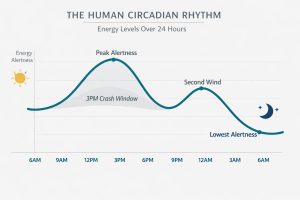
Research shows approximately 20% of people experience a pronounced afternoon dip in mental energy, even when they control for what they ate and how they slept (Monk, 1989).
The crash wasn’t tied to lunch. It was tied to the time of day.
Your Brain Runs on ATP (And You’re Running Low)
Every thought you have, every word you type, every decision you make requires energy at the cellular level. That energy comes from ATP.
ATP is adenosine triphosphate. It’s the fuel your cells use to do literally everything.
Your brain represents about 2% of your body weight. But it uses roughly 20% of your total energy at rest. When you’re focused, working, or problem solving, that number goes even higher.
By 3pm, you’ve been awake for 7 to 9 hours. Your cells have been burning through ATP all morning. Your mitochondria (the parts of your cells that make ATP) are working hard to keep up.
And then your circadian rhythm dips.
When that happens, your mitochondria become less efficient. They produce less ATP at the exact moment your brain needs more of it.
At the same time, a molecule called adenosine has been building up in your brain since you woke up. Adenosine is a byproduct of energy use. The more ATP you burn, the more adenosine accumulates. And adenosine tells your brain it’s time to rest.
So at 3pm, you get hit twice: less energy being made, more fatigue signals piling up.
Coffee helps because it blocks adenosine receptors temporarily. But it doesn’t solve the real problem. Your cells are still running low on usable energy.
Why Some People Hit the Wall Harder
Not everyone crashes the same way.
Some people barely notice the afternoon dip. Others lose an hour or more of productive time.
The difference comes down to how well your mitochondria are functioning.
A 2021 study looked at mitochondrial function in older adults. Those who reported significant afternoon fatigue had measurably lower ATP production in their cells (Herpich et al., 2021). The fatigue wasn’t just in their heads. It was metabolic.
Things that compromise mitochondrial function:
Chronic stress damages mitochondrial membranes over time.
Poor sleep interferes with mitochondrial repair (which happens mostly during deep sleep).
Nutrient gaps matter more than most people realize. ATP production requires B vitamins, magnesium, CoQ10, and other cofactors. Even small deficiencies reduce energy output.
 Blood sugar swings make it harder for your cells to use fuel efficiently.
People with resilient mitochondria still experience the dip. But it’s a slight softening of focus, not a wall.
People with compromised mitochondrial function hit that wall hard.
What Actually Helps (According to the Research)
You can’t eliminate the circadian dip. It’s hardwired into your biology.
But you can support the systems that produce cellular energy.
Research on compounds that support ATP production shows measurable improvements in cognitive performance during periods of high demand or depleted energy reserves.
Creatine acts as a rapid ATP buffer. It helps cells regenerate energy more quickly during periods of high metabolic demand. Studies show it improves performance on tasks requiring short-term memory and reasoning, especially in people experiencing mental fatigue or sleep deprivation.
CoQ10 and L-carnitine support mitochondrial function and help maintain steadier energy output across the day.
B vitamins and magnesium are required cofactors for ATP production. Without them, the whole system slows down.
Supporting mitochondrial function doesn’t eliminate the dip. But it reduces how hard the crash hits and how long it lasts.
Why the 3pm Scan Matters
Most people guess about their energy levels.
The Vital Blink 3pm Brain Speed Scan measures your cognitive performance at the exact time your energy systems are most vulnerable.
It evaluates processing speed, working memory, and mental stamina during the afternoon window when your circadian rhythm dips and your mitochondrial energy output is under the most pressure.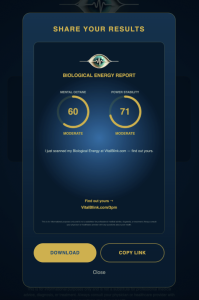
If your scores drop significantly during the 3pm window, that’s a signal your cellular energy systems need support.
If your scores hold steady, that’s evidence your mitochondria are resilient enough to carry you through the dip.
Either way, you’re working with real data instead of guessing.
What Calm Energy Was Built to Do
We built Calm Energy around one simple idea: support the biological systems that actually produce cellular energy.
Not stimulation. Not masking the crash with caffeine. Actual mitochondrial support.
Every ingredient targets a specific part of the ATP production pathway:
5g creatine monohydrate buffers ATP in brain cells, helping you regenerate energy faster during cognitive demand.
L-theanine, citicoline, and L-tyrosine support neurotransmitter production and mental clarity without stimulation.
CoQ10 and ALCAR support mitochondrial function directly.
Magnesium, B6, and B12 provide the cofactors ATP production requires.
This isn’t about forcing your body to do something it doesn’t want to do. It’s about giving your cells what they actually need to sustain energy production when your circadian rhythm dips.
The 3pm crash is predictable. So is the solution.
Find Out Where You Stand
Take the 3pm Brain Speed Scan. 90 seconds. Real data. No guessing.
Then decide if supporting your mitochondria makes sense for you.
References
- Blatter, K., & Cajochen, C. (2007). Circadian rhythms in cognitive performance: Methodological constraints, protocols, theoretical underpinnings. Physiology & Behavior, 90(2-3), 196-208. https://www.sciencedirect.com/science/article/pii/S0001691821001037
- Monk, T. H. (1989). A visual analogue scale technique to measure global vigor and affect. Psychiatry Research, 27(1), 89-99. https://pubmed.ncbi.nlm.nih.gov/38970987/
- Lawson, N., Hsieh, C. H., March, D., & Wang, X. (2024). Mitochondrial dysfunction in myalgic encephalomyelitis/chronic fatigue syndrome. Frontiers in Physiology, 15. https://pmc.ncbi.nlm.nih.gov/articles/PMC11305905/
- Herpich, C., Franz, K., Klaus, S., Müller-Werdan, U., Ost, M., & Norman, K. (2021). Age-related fatigue is associated with reduced mitochondrial function in peripheral blood mononuclear cells. Experimental Gerontology, 144, 111177. https://www.sciencedirect.com/science/article/abs/pii/S1746809416300805