



After 50, the same cup of coffee that once cleared your system before dinner can still be half-active at midnight. Most people are never told this.
 conversation from last Tuesday.You lie there. You try to fall back asleep. You wonder if this is just what aging feels like now.One thing almost nobody connects to this picture: the coffee finished at 2pm.
What Actually Changes in Your Sleep After 50
Sleep architecture shifts with age. Deep slow-wave sleep, the most restorative stage, becomes shorter. You spend more time in lighter sleep stages, which makes you easier to wake and harder to keep asleep. This is a normal biological shift, not a disorder.
But it narrows the margin. Things that used to clear your system before bed no longer do. Substances that once caused minor disruption now tip the balance. Caffeine is the most common and the most overlooked.
A 2025 meta-analysis of 22 controlled crossover trials, published in Sleep Medicine, found that caffeine significantly reduces total sleep time by an average of 34.67 minutes and delays sleep onset by more than 8 minutes. That disruption is not subtle. And it compounds directly when caffeine has not finished clearing your system before you get into bed.
The Half-Life Your Body Used to Have
In your 20s and 30s, caffeine cleared your system in roughly 4 to 5 hours. A 2pm coffee was largely gone by 7 or 8pm. That math made afternoon coffee feel harmless, because for most people, it was.
After 50, that math changes.
Caffeine is processed primarily in the liver by an enzyme called CYP1A2. As we age, CYP1A2 activity slows, and caffeine clearance can take 30 to 50 percent longer than it did in earlier decades. For slow metabolizers, and research suggests roughly half the population carries a gene variant associated with slower caffeine clearance, the half-life extends to 7 to 10 hours.
That cup you finished at 2pm can still have half its caffeine load active in your system at 11pm or midnight. That is not a sleep problem. That is pharmacokinetics working against you while you lie there wondering why your brain will not stop.
What Is Caffeine Half-Life?
Caffeine half-life is the time required for your body to eliminate half the 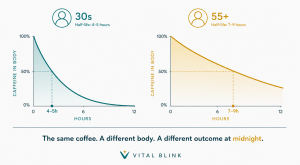 caffeine in your bloodstream. Consume 200mg and your half-life is 5 hours: you still have 100mg active 5 hours later. If your half-life is 9 hours, that same cup taken at 2pm still has 100mg circulating at 11pm. Half-life is determined primarily by the CYP1A2 enzyme in the liver. Activity of this enzyme slows with age and varies considerably between individuals based on genetics, smoking status, and hormonal changes including those associated with menopause and perimenopause.
What Caffeine Is Actually Doing at 2am
Sleep drive is built on a compound called adenosine. It accumulates in the brain throughout every waking hour. The longer you are awake, the more adenosine builds, and the more pressure your brain feels toward sleep. This is the biological system designed to make you tired by evening.
Caffeine works by blocking adenosine receptors. It does not remove adenosine. It prevents your brain from reading the signal. When caffeine wears off, the adenosine that accumulated while the receptors were blocked floods back in, which is why a crash often follows a coffee high.
If caffeine is still occupying those receptors at midnight, your brain cannot accurately read how tired you are. Sleep becomes harder to initiate and easier to interrupt. The racing thoughts at 2am are not anxiety about nothing. They are a brain that does not yet know it is supposed to be resting.
What Is Adenosine?
Adenosine is a neuromodulatory compound that accumulates in the brain during waking hours and creates what sleep researchers call sleep pressure:  the mounting biological drive to sleep. Adenosine binds to receptors in the brain, signaling that rest is needed. Caffeine is a competitive antagonist of these receptors, meaning it occupies the receptors without activating them and effectively mutes the sleep signal. After 50, because caffeine stays in the system longer, this receptor blockade extends further into the night than it did in earlier decades, disrupting the brain’s natural ability to wind down.
Three Things Worth Trying
None of these require a program or a complete overhaul. Pick one. Try it for a week.
- Move your caffeine cutoff earlier than feels necessary. Given the slower
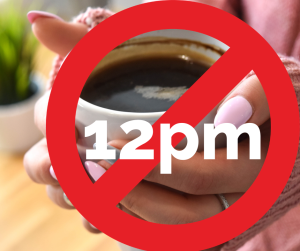 clearance common after 50, stopping caffeine by noon gives your liver a real window to finish processing before a typical bedtime. If noon feels extreme, start by moving your current cutoff back 30 minutes and hold it consistently for 7 days. One shift, held consistently, often produces noticeable change in sleep onset and middle-of-the-night waking before anything else changes.
 - Use slow exhalation to move your nervous system out of alertness. When you wake at 2am with a running brain, the problem is often that your sympathetic nervous system is still dominant. A prolonged exhale activates the vagus nerve and shifts you toward parasympathetic state. Try inhaling for 4 counts, holding for 7, and exhaling slowly for 8. Three rounds. Research on slow exhalation consistently shows reduced heart rate and measurable parasympathetic activation. It will not put you to sleep in minutes, but it can interrupt the loop enough for sleep to return on its own.
- Get out of bed if you have been awake and wired for 20 minutes. Staying in bed frustrated trains your brain to associate bed with wakefulness rather than sleep. This is well-documented in sleep research and forms a core principle of cognitive behavioral therapy for insomnia. Get up. Sit somewhere quiet in low light. Return when you feel sleepy again. It sounds counterintuitive. It works because it protects the association your brain needs to sleep well in that space.
My Perspective
I built Vital Blink’s first formula around zero stimulants specifically because of this problem.
Not because stimulants have no place. But because anything designed for afternoon use needs to work within your body’s clearance windows, not extend past them. When your afternoon support does not run a tab you pay at midnight, everything that follows changes: the wind-down, the sleep onset, and the quality of what you actually get.
The chemistry of how your body handles caffeine changes after 50. The choices you make with that information can change too.
Frequently Asked Questions
Why do I wake up at 2am and struggle to fall back asleep?
Waking in the early morning hours is one of the most common sleep changes after 50. Lighter sleep architecture makes you easier to rouse, while substances like caffeine that have not fully cleared can prevent the brain from recognizing and responding to sleep signals. Addressing caffeine timing is one of the most accessible first steps before assuming a deeper disorder is present.
How long does caffeine stay in your system after 50?
For adults over 50, caffeine half-life commonly extends to 7 to 9 hours, compared to 4 to 5 hours in earlier decades. This is due to slowing CYP1A2 enzyme activity in the liver with age. Genetic variation also plays a significant role: approximately half the population carries a variant associated with slower caffeine metabolism, meaning the effect is not uniform but the direction of change with age is consistent.
What time should I stop drinking caffeine to sleep better?
Based on the extended half-life common after 50, stopping caffeine by noon provides adequate clearance time before a typical 10pm or 11pm bedtime. If noon is not feasible, starting by moving your cutoff back 30 minutes and holding it consistently for one week is a practical first step that produces measurable results for many people without any other change.
What does slow exhalation actually do for sleep?
Slow, controlled exhalation activates the vagus nerve, the primary pathway for parasympathetic regulation. Increased vagal tone slows heart rate, lowers cortisol, and signals the brain that no threat requires attention. Research on controlled breathing consistently demonstrates reduced sympathetic nervous system activity and improved heart rate variability. Extended exhale ratios produce stronger parasympathetic response than equal-ratio or fast breathing patterns.
Is the 2am waking pattern related to menopause?
Hormonal shifts during perimenopause and menopause, particularly declining estrogen and progesterone, do affect sleep architecture and can contribute to nighttime waking. However, the pharmacokinetic changes in caffeine metabolism after 50 occur independently of hormonal status and affect both women and men. When both factors are present together, they compound each other. Addressing caffeine timing is worthwhile regardless of hormonal context because it targets a distinct and controllable mechanism.
Want science-backed support built for how your body actually works after 50?
Sources: Huang S et al. Age- and dose-specific effects of caffeine on sleep: A meta-analysis of controlled crossover trials. Sleep Medicine. 2025. sciencedirect.com/science/article/abs/pii/S1389945725005490 | Gardiner C et al. The effect of caffeine on subsequent sleep: A systematic review and meta-analysis. Sleep Medicine Reviews. 2023;69:101764. pubmed.ncbi.nlm.nih.gov/36870101 | Vistisen D et al. Variability of cytochrome P450 1A2 activity over time in young and elderly healthy volunteers. British Journal of Clinical Pharmacology. 2004;57(2):178-184. pmc.ncbi.nlm.nih.gov/articles/PMC2014598 | Porkka-Heiskanen T, Kalinchuk A. Adenosine, energy metabolism and sleep homeostasis. Sleep Medicine Reviews. 2011;15(2):123-135. | Jerath R et al. Physiology of long pranayamic breathing: neural respiratory elements may provide a mechanism that explains how slow deep breathing shifts the autonomic nervous system. Medical Hypotheses. 2006;67(3):566-571. | Morin CM et al. Cognitive behavioral therapy, singly and combined with medication, for persistent insomnia. JAMA. 2009;301(19):2005-2015. pubmed.ncbi.nlm.nih.gov/19454639 | Note: Verify all URLs and PubMed IDs before publishing.