



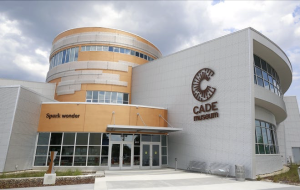
Last May, I was invited to an opening exhibition at the Cade Museum of Creativity and Innovation by dear friends who founded the museum, Phoebe and Richard Miles.
There’s a personal thread woven into that moment.
Phoebe’s father, Bob Cade, and my father were researchers together at the University of Florida and close friends. Science, curiosity, and long conversations were part of the fabric long before this exhibition ever existed.
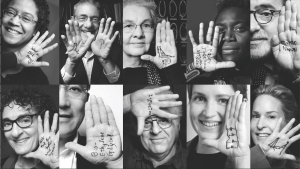
The exhibit was Fascination of Science, by Herlinde Koelbl
At 86, she is sharp, grounded, and deeply present. Widely recognized as one of Germany’s most significant contemporary photographers and documentary filmmakers, she is known for long-term projects that take years, sometimes decades, to unfold.
Whether she’s photographing scientists or world leaders, she has a rare ability to get people to lower their guard. That trust doesn’t come from technique alone. It comes from wisdom, patience, and genuine curiosity.
Her process in this exhibition was deceptively simple.
She interviewed scientists.
Then she asked them to write on their own hand the sentence that motivates them.
By combining text (intellectual motivation) with gesture (subconscious expression), she created something more than a portrait. It felt like a three-dimensional glimpse of the person, not just their face, but their inner architecture.
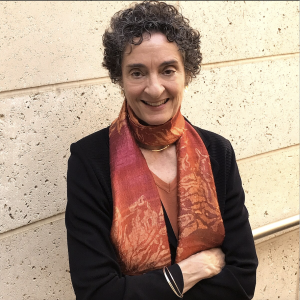 One of those scientists was Carla Shatz. She wrote:
Cells that fire together wire together.
Seeing that sentence written on her hand sparked more interest… Not because it was poetic, but because it pointed directly to decades of rigorous research.
Carla Shatz helped establish how neuroplasticity works in real biological systems. Her research showed that experience and repetition change how neurons connect and communicate.
When neural circuits are activated repeatedly, those connections strengthen. When they are not, they weaken, fade.
This is a core principle of how the brain adapts across the lifespan.
Every time you learn something unfamiliar, struggle through a new movement, engage in deep conversation, or persist through discomfort, your brain is wiring itself for resilience.
This is what builds cognitive reserve… a buffer that supports function as we age.
And here’s where the art and the science meet.
Koelbl’s work shows that motivation isn’t abstract. It lives in the body. In posture. In gesture. In what we return to again and again.
What we repeat — thoughts, movements, habits — reshapes us.
So I keep asking myself: What am I wiring today?
Because at this stage of life, we’re not just maintaining… We’re still building.
Small things, repeated often, are not small.
If you had to write one sentence on your hand—the one that keeps you moving forward—what would it be?