




Brain Fog in Menopause: 5 Proven Reasons Your Brain Feels Different After 50
The focus gaps, the word retrieval losses, the reactions that surprise you — brain fog during menopause has a neurological explanation. And it has nothing to do with stress.
You walk into the kitchen and forget why you went there.
You’re in a conversation and the word you need just disappears. You know it. It’s right there. It won’t come.
Someone says something minor and your reaction surprises even you.
Brain fog in menopause is one of the most common and least explained experiences women describe at this stage — and you are not imagining it. Up to 60 percent of women going through menopause report it. Something in your brain changed, and it has a name.
Your Brain Has Two Systems That Used to Work Together
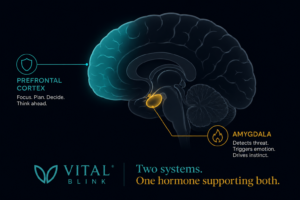
Think of your brain as having two main players when it comes to thinking and feeling.
The first is your prefrontal cortex. It sits right behind your forehead. It handles focus, decisions, staying calm under pressure, and filtering out distractions. It’s the part of your brain that says: wait, think this through before you react.
The second is your limbic system — specifically the amygdala. This is your alarm system. It scans for threats constantly. It fires first and asks questions later. It’s fast, reactive, and emotional.
In a healthy, balanced brain, these two systems talk to each other constantly. The prefrontal cortex keeps the amygdala from running the show. They check and balance each other all day long.
After menopause, that balance shifts. And the reason is something most women are never told about.
Why Estrogen Is at the Center of Brain Fog Menopause Symptoms
Estrogen is not just a reproductive hormone. It works directly in your brain.
Estrogen receptors sit in both your prefrontal cortex and your amygdala. Estrogen supported the brain’s chemical messengers — specifically dopamine and serotonin — that power focus, working memory, word recall, and mood. And it actively calmed amygdala reactivity, helping your brain pump the brakes on emotional responses before they escalated.
When estrogen drops — which it does, sharply, during perimenopause and menopause — both systems feel it at the same time. This is the direct biological driver behind brain fog menopause research consistently identifies as the most reported cognitive symptom at this stage.
What Is Estrogen’s Role in the Brain?
Estrogen receptors are concentrated in the hippocampus (memory and learning), the amygdala (emotional processing), and the prefrontal cortex (executive function and focus). Estrogen modulates dopamine and serotonin activity in these regions — the same neurotransmitters that support attention, word recall, working memory, and emotional regulation. When estrogen declines, these regions receive less hormonal support, which is why cognitive and emotional symptoms tend to appear together during menopause, not separately.
What You Notice on the Focus Side
The prefrontal cortex, running with less estrogen support, becomes less efficient. This is the cognitive side of what brain fog menopause brings — distinct from emotional reactivity, and just as disruptive.

You notice it as slower processing. Things take longer to come together in your mind. Decision fatigue hits earlier in the day — small choices feel heavier than they should. And the word retrieval gaps. You know the word. It’s right there. It just won’t surface. This is one of the most common things women describe at this stage, and one of the most unsettling.
Distractions are harder to filter out. Focus takes more effort and does not last as long as it used to.
None of this means your brain is damaged. It means it is running on less of a hormone it relied on to stay efficient.
What You Notice on the Emotional Side
The amygdala, with less estrogen to regulate it, becomes more reactive. This is the emotional dimension of brain fog menopause — the part that is hardest to explain to people around you.
Small things feel bigger. Your patience runs shorter than it used to. You might feel anxious in situations that never used to bother you. Or you find yourself crying and not quite knowing why.
This is not a personality change. It is your brain’s alarm system firing with less of the chemical buffer that kept it in check for decades.
One more thing worth knowing. The amygdala stores emotional memory. When it is running hot, past experiences — frustrations, fears, old patterns — can surface more easily than they used to. What feels like an outsized reaction in the present often has roots in an overactive memory system.
This is not a character flaw. It is neurological.
The Good News: These Systems Respond to Input
Your brain is not static. It changes based on what you give it. And several things directly support the prefrontal cortex and calm the amygdala — without requiring estrogen levels to return to what they were at 35.
Sleep. Deep sleep is when your brain consolidates memory, clears metabolic waste, and rebalances. Poor sleep accelerates the cognitive effects of menopause. Good sleep slows them. This is not optional.
Consistent exercise. Regular movement — not intense, just consistent — increases a protein called BDNF that supports brain cell growth and prefrontal function. It also reduces amygdala reactivity over time. Research on long-term exercise shows measurable improvements in brain waste clearance and cognitive performance in women over 50. See how resistance training supports both muscle and brain health after 50.
Anti-inflammatory nutrition. Neuroinflammation is a driver of cognitive decline. What you eat either fuels it or reduces it. A Mediterranean-style eating pattern is the most researched for brain protection at this stage.
Creatine. This one surprises people. Creatine supports cellular energy in the brain, not just in muscles. Research shows cognitive benefits in adults over 50 — particularly for memory and processing speed under mental load.
Reducing chronic stress. The amygdala and stress hormones are in a feedback loop. Chronic high cortisol makes amygdala reactivity worse over time. Anything that genuinely lowers your stress — not just numbs it — helps recalibrate the system.
What Is BDNF?

BDNF stands for Brain-Derived Neurotrophic Factor. Think of it as fertilizer for your brain cells. It supports their growth, survival, and connection to each other, and it is directly linked to memory, learning, focus, and mood. Exercise is one of the strongest natural stimulants of BDNF production. Resistance training and aerobic exercise both trigger it — through different but complementary pathways — which is why combining both produces stronger cognitive results than either alone.
My Perspective
When I started looking into this, I expected to find general wellness advice. What I found instead was specific, documented neuroscience about what estrogen was doing inside my brain — and what changed when it declined.
That knowledge did not fix everything. But it changed how I thought about what I was experiencing. The brain fog was not a failure. The emotional reactivity was not weakness. They were signals from a system adapting to a different hormonal environment.
Knowing that made it easier to give my brain what it actually needed, instead of wondering what was wrong with me.
That is what this pillar is for.
Frequently Asked Questions
Is brain fog a normal part of menopause?
Research shows that up to 60 percent of menopausal women experience brain fog. It is common, but it is not inevitable or permanent. It is driven primarily by the decline in estrogen’s support of the prefrontal cortex and the neurotransmitters — dopamine and serotonin — that power focus, word recall, and working memory.
Why am I more emotionally reactive after menopause?
Estrogen helped regulate amygdala activity — your brain’s alarm system. When estrogen declines, the amygdala becomes more reactive with less hormonal buffering. This is a neurological change, not a personality change. Sleep, exercise, and stress reduction all help recalibrate this system over time.
Can the prefrontal cortex recover function after menopause?
Yes. The brain responds to input at any age. Sleep quality, consistent exercise, anti-inflammatory nutrition, and creatine supplementation all have research support for improving prefrontal function and reducing cognitive symptoms associated with menopause.
What does creatine do for the brain?
Creatine supports cellular energy production in the brain as well as in muscle tissue. Research in adults over 50 shows benefits for memory and processing speed under mental load. It is one of the more underrecognized cognitive supports for women at this stage.
How is this related to the glymphatic system?
The glymphatic system clears metabolic waste from the brain during deep sleep — including the proteins most associated with cognitive decline. After menopause, glymphatic efficiency declines more sharply in women, partly because estrogen supported the blood vessel function this system depends on. Sleep quality and brain health are more connected than most people realize. Read more about the glymphatic system here.
Want evidence-based tools built for your brain after 50?
Ready for the next step? Get early access to Calm Energy, our first signature formula.
Sources: Shanmugan S, Epperson CN. Estrogen and the prefrontal cortex: towards a new understanding of estrogen’s effects on executive functions in the menopause transition. Human Brain Mapping. 2014;35(6):2755-2763. pmc.ncbi.nlm.nih.gov/articles/PMC4104582 | Zeidan MA et al. Estradiol modulates medial prefrontal cortex and amygdala activity during fear extinction in women and female rats. Biological Psychiatry. 2011;70(10):920-927. pmc.ncbi.nlm.nih.gov/articles/PMC3197763 | Sherwin BB. Estrogen and cognitive aging in women. Neuroscience. 2006;138(3):1021-1026. pubmed.ncbi.nlm.nih.gov/16310963 | Cotman CW, Berchtold NC. Exercise: a behavioral intervention to enhance brain health and plasticity. Trends in Neurosciences. 2002;25(6):295-301. pubmed.ncbi.nlm.nih.gov/12086747 | Note: Verify all PubMed links before publishing.